Holly in the Celtic Tree Calendar: Protection, Devotion & the Spiritual Warrior

One year ago, Holly was the very first tree I explored when I began following the Celtic Lunar Tree Calendar.

At the time, I was learning in real time. I’d spent the previous few years honoring the New and Full Moons through Western astrology, but that framework had started to feel flat to me, not to mention overwhelming. I found myself craving something more rooted in the Land, the Seasons, my ancestry, and the living world around me.

So in July of 2025, I started with Holly.

Then Holly became Hazel, Hazel became Vine, the Seasons changed, and I kept going.

Thirteen trees later, I arrived at Oak and realized I’d completed an entire journey around the wheel.

And now I’m back where I started.

Except I’m not.

The tree is the same. I’m not.

That’s one of the things I’m most curious about as I begin my second journey around the Celtic Lunar Tree Calendar.

Last year, I was mostly asking:

What does this tree mean?

This year, I’m asking:

What does this tree reveal now that I’ve changed?

Because one of the beautiful things about circles is that they don’t really end.

They deepen.

In the version of the Celtic Lunar Tree Calendar I follow, Holly follows Oak and begins with the New Moon that falls in late July or August.

Because I follow the trees according to actual lunar cycles rather than assigning them fixed Gregorian calendar dates, the exact beginning and ending dates shift from year to year.

That’s part of what I love about it.

The calendar doesn’t ask the Moon to conform to us.

We pay attention to her.

Holly carries us into late summer, after the Summer Solstice, when the days are still long and abundant but the light has already begun its slow decline toward the darker half of the year.

And that matters to Holly’s teaching.

Because although many of us associate Holly with Christmas and winter, she begins preparing long before winter arrives.

Holly is an evergreen.

When much of the landscape becomes bare and dormant, Holly remains green. Her bright berries provide color and food during a Season when both become harder to find.

And, of course, she has those unmistakable prickly leaves.

Holly has long been associated with protection, strength, endurance, devotion, and the preservation of Life through difficult Seasons.

Last year, I came to think of Holly as the Sacred Defender.

At the time, her central question for me was:

What deserves my devotion?

A year later, I’m realizing that question has another side.

Because once we recognize what’s sacred, something else inevitably follows.

We have to protect it.

Last month, Oak asked:

What are you becoming rooted in?

For me, the answer became my own True Nature.

Oak reminded me of the acorn, holding within itself everything it needs to become an oak. It helped me see healing less as an endless project of fixing and improving myself and more as removing what obscures the Nature that was there all along.

And now Holly arrives and seems to say:

Then protect it.

Protect the Life you’re actually trying to live.

Protect your attention.

Protect your creativity.

Protect your body.

Protect your relationships.

Protect your time.

Protect your relationship with Nature.

Protect the things you’ve finally realized are sacred.

Maybe this is the deeper question Holly is asking me on my second journey around the wheel:

What does my devotion require me to protect?

The actual Holly plant makes this even more interesting.

One of the things I learned while researching Holly is that her leaves aren’t equally prickly everywhere.

Holly can alter the shape of its leaves in response to browsing animals. Leaves growing lower on the plant, where they’re more vulnerable to being eaten, can develop more pronounced spines, while leaves higher up and farther from browsing animals may be much smoother.

I can’t stop thinking about that.

Holly doesn’t armor everything equally.

She protects herself where protection is needed.

That’s a much more nuanced understanding of boundaries than simply becoming harder, more defended, or less accessible.

The question isn’t:

How do I protect myself from everything?

It’s:

Where is protection actually needed?

Because Holly’s defenses don’t prevent her from participating in relationship.

Quite the opposite.

Her dense evergreen growth creates shelter for wildlife, and her berries provide food during winter.

Holly is both protected and hospitable.

She has thorns and creates sanctuary.

What if those things aren’t opposites?

What if boundaries are part of the architecture that makes sanctuary possible?

I’ve been thinking about this a lot in my own Life.

There have been Seasons when I unconsciously equated Love with access.

If I loved someone, I should be available.

If I cared, I should help.

If something mattered, I should give it more of myself.

But I’ve increasingly realized that Love doesn’t require unlimited access.

And protection doesn’t necessarily mean closing my heart.

Sometimes the boundary is precisely what allows my heart to remain open.

Holly doesn’t teach me to become prickly everywhere.

She teaches me to become discerning about where I need thorns.

When I met Holly last year, devotion was the word that wouldn’t leave me alone.

I was asking what I wanted to orient my Life around, what deserved my focus, and what I was willing to hold sacred even when everything around me competed for my attention.

A year later, I have more answers.

I’ve become more devoted to my actual lived experience of Life.

Not just what I accomplish.

Not what I optimize.

Not how much I can fit into a day.

I mean what it actually feels like to be alive inside my own Life.

I’ve become more devoted to spaciousness, deep time, meaningful conversations, time outside, family, pleasure, rest, seasonal rhythms, and the quality of my attention.

This Summer, that’s looked like working fewer days, taking sunset walks with my family, spending mornings outside instead of automatically sitting inside at my altar, and remembering that Nature is my altar.

It’s looked like going to the beach, traveling, dancing at concerts, spending time with people I Love, and intentionally creating moments that feel different from the rest of the year.

I’ve become more devoted to allowing my business to support my Life instead of organizing my Life around the fabricated endless demands of capitalism.

I’ve become more devoted to my own Timing.

My own Inner Authority.

My own True Nature.

And I’ve become much less devoted to urgency.

Optimization.

Constant self-improvement.

Being endlessly available.

Producing simply because I can.

Keeping every possibility alive.

And perhaps most importantly, I’ve become less devoted to the belief that Love requires self-abandonment.

That’s where Holly feels completely different to me this year.

Last year, Holly asked me to choose my devotion.

This year, I’m realizing:

Devotion requires protection.

If I say my family is sacred, my calendar has to reflect that.

If I say my relationship with Nature is sacred, I have to actually go outside.

If I say spaciousness is sacred, I can’t fill every opening.

If I say my attention is sacred, I can’t give everything equal access to it.

If I say my creativity is sacred, I can’t demand that every idea immediately become productive.

Every meaningful yes creates a no somewhere else.

That’s not selfishness.

That’s devotion.

As I begin my second journey around the Celtic Lunar Tree Calendar, I’m also adding another layer to my practice.

I’ve been reading Ted Andrews’ Nature-Speak, a book about receiving intuitive messages through the plants, animals, signs, omens, encounters, and patterns we notice in Nature.

I love the idea of moving beyond simply learning what a tree has historically symbolized and becoming more attentive to what an encounter with that tree might be inviting us to notice in our own Life.

Andrews associates Holly with the spiritual warrior and with becoming clear about our purposes.

He also connects Holly with protection, assertiveness, focused energy, emotional expression, and the importance of not scattering ourselves in too many directions.

The phrase spiritual warrior can sound combative.

But that’s not how I’m understanding it.

The spiritual warrior isn’t fighting everything. She’s clear about what she’s fighting for.

That changes the whole archetype for me.

The spiritual warrior doesn’t need an enemy.

She needs devotion.

She knows what matters enough to protect.

She knows where her energy belongs.

And because she knows what she’s devoted to, she can recognize what doesn’t deserve equal access to her energy.

I think this is especially important for women.

So many of us have learned to scatter ourselves across the needs, expectations, emotions, requests, schedules, and desires of everyone around us.

We can become incredibly skilled at caring for everything without ever stopping to ask:

Is this actually mine to tend?

Holly invites us to gather our energy back.

Not to hoard it.

Not to close ourselves off.

To direct it.

There’s another aspect of Andrews’ interpretation of Holly that I find especially beautiful.

Alongside the Spiritual Warrior, he connects Holly with the heart, compassion, Love, and healthier emotional expression.

At first, those might seem like completely different teachings.

Protection.

Assertiveness.

Thorns.

Love.

Compassion.

An open heart.

But I actually think they belong together.

Maybe the opposite of boundaries isn’t Love.

Maybe healthy boundaries are one of the ways we protect our capacity to Love.

Maybe saying no before resentment builds is Loving.

Maybe creating distance from a relationship that continually pulls us out of ourselves can allow us to hold that person with more compassion.

Maybe protecting our rest allows us to become more generous.

Maybe protecting our creative energy allows us to actually make the thing that wants to come through us.

Maybe protecting our attention allows us to become more present with the person sitting in front of us.

Holly doesn’t ask us to choose between the open heart and the thorn.

She shows us how they can belong to the same plant.

This was one of the things that initially confused me about Holly.

Holly feels like a winter tree.

We associate her glossy green leaves and red berries with Christmas, Yule, wreaths, winter decorations, and the darkest part of the year.

So why meet Holly in late summer?

Because winter doesn’t begin in winter.

Nature is always preparing for the Season ahead.

By the time Holly’s winter abundance becomes obvious to us, a much longer process has already unfolded.

And by the time we reach Holly in the lunar wheel, something similar is happening around us.

The Summer Solstice has passed.

The days are shortening.

Holly reminds us that preparation doesn’t have to come from anxiety.

We don’t prepare for winter because we distrust the cycle.

We prepare because we trust it.

There’s a difference.

One says:

Something bad might happen. I need to control everything.

The other says:

I know the Season will change. What can I lovingly tend now that will support me then?

That’s another question I’m carrying with me through this Holly Moon:

What am I tending now that I’ll need later?

Holly has a long history in the folklore and seasonal customs of Britain and Ireland, particularly as a protective evergreen.

Its ability to remain green through winter made it an obvious symbol of enduring Life when much of the surrounding landscape appeared dead or dormant.

Holly was traditionally brought into homes during the winter Season, and later folklore connected it with protection from harmful influences as well as shelter for benevolent spirits and fairy beings.

You may also encounter the story of the Holly King and Oak King, two seasonal figures who battle for dominance as the light waxes and wanes throughout the year.

It’s a beautiful mythic image, and one I explored during my first year with Holly.

But it’s worth knowing that the familiar Holly King/Oak King story is better understood as part of modern Pagan tradition than as a clearly documented ancient Celtic myth.

That’s something I’m trying to be more intentional about during my second journey around the wheel.

I want to enjoy mythology, folklore, intuitive interpretation, and modern spiritual practice without needing everything meaningful to be thousands of years old.

Something doesn’t have to be ancient to be sacred.

And something being ancient doesn’t automatically make it true for me.

I want a spirituality that’s rooted enough to care about where our stories come from and alive enough to keep making meaning in relationship with the world we’re actually living in.

This year, I want to add this question to every tree we explore:

What might I notice if this tree actually appears in my Life?

I don’t believe every Holly bush you pass is necessarily delivering a cosmic telegram.

But I do believe attention changes our relationship with the world.

So if Holly keeps catching your attention this month, you might pause.

Look at the leaves.

Notice whether they’re prickly or smooth.

Notice what the plant is protecting.

Notice what it’s sheltering.

Notice the birds.

Notice where it’s growing.

Then turn the questions inward.

Where is my energy scattered?

What deserves more focused attention?

What am I protecting?

What am I failing to protect?

Where do I need greater assertiveness?

Where have I become unnecessarily defended?

What am I fighting against?

What am I fighting for?

And perhaps most importantly:

What do I Love enough to protect?

If you were born during the Holly Moon, I think of Holly as part of your Birth Essence.

Holly carries the archetype of the Sacred Defender and the Spiritual Warrior.

You may have a natural instinct to protect what and who you Love, hold steady through difficult Seasons, advocate for others, or remain devoted long after other people have lost interest.

Your strength can create safety for other people.

But Holly’s deeper lesson may be discernment.

Not everything needs defending.

Not every problem is yours to solve.

Not everyone needs access to you.

And strength doesn’t mean carrying everything.

Your highest expression isn’t becoming endlessly armored.

It’s learning where your thorns belong.

It’s allowing your strength to exist in service of Love rather than fear.

It’s knowing what matters enough to protect and directing your considerable energy toward that.

Your strength becomes sanctuary when it’s guided by devotion.

As you walk with Holly this lunar cycle, you might spend some time with these questions:

  • What am I genuinely devoted to in this Season of my Life?
  • What does that devotion require me to protect?
  • What deserves more access to my time, attention, energy, and Love?
  • What deserves less?
  • Where does my Life genuinely need a thorn right now?
  • Where might I still be armored even though protection is no longer necessary?
  • Where is my energy becoming scattered?
  • What am I fighting against, and what am I actually fighting for?
  • What boundary might allow my heart to become more open rather than less?
  • What am I tending now that I’ll need in another Season?
  • What would change if I treated my attention as sacred?
  • What does being a Spiritual Warrior mean to me if I remove the need for an enemy?

You don’t have to answer all of them.

Choose the one that makes something inside you move.

That’s usually the one worth following.

Last year, Holly asked me:

What deserves my devotion?

I spent a year answering.

Not perfectly.

Not all at once.

But through the thousands of tiny choices that eventually become a Life.

And now I’ve returned to her.

This time, she seems to be asking:

What does your devotion require you to protect?

Maybe that’s what it means to travel around a spiritual wheel.

We don’t collect thirteen answers and graduate.

We return.

The Moon circles.

The Seasons return.

The tree is waiting.

And somehow, the same question contains something we couldn’t hear the first time.

The tree hasn’t changed.

But I have.

Circles don’t really end.

They deepen.

Follow Along With Me

If you’d like to keep walking the Celtic Lunar Tree Calendar with me, I’d love to have you.

Each New Moon, I’ll share the next tree guide, exploring its ecology, Celtic folklore and symbolism, intuitive teachings, seasonal wisdom, and reflection questions to carry with you through the lunar cycle.

Get the next Celtic Lunar Tree Guide in your inbox as we move through all 13 trees together.

← Back

Thank you for your response. ✨

The Celtic Tree Calendar: A Guide to the 13 Lunar Trees & How I Follow the Wheel

A little over a year ago, I found myself asking a question I ask about a lot of things these days:

What would my ancestors have done?

For several years, I’d followed the New and Full Moons through Western astrology. I’d look at which zodiac sign the Moon was moving through, learn about the themes associated with it, and share what I was noticing with my community.

That framework had been meaningful for me.

And then, slowly, it started feeling flat.

Not wrong.

Just no longer alive for me.

I’d experienced this before. Sometimes a practice, teacher, belief, or framework can be exactly what we need for a Season, and then one day we realize we’ve grown into a bigger shell.

I wanted something that felt more rooted in the Earth beneath my feet.

Something connected to the actual Season I was living through, the Moon I could see in the sky, the plants growing around me, and the Land itself.

I wanted something I could feel in my blood and bones.

After visiting the Land of my ancestors in Portugal for my first psychedelic retreat in 2022, returning to my paternal ancestral homeland of the Azores, and later traveling through my maternal ancestral homeland of the British Isles, I’d become increasingly curious about the spiritual worldview of the people who came before me.

Not because I wanted to perfectly recreate the past.

I wanted to remember a way of being in relationship with the living world.

That curiosity eventually led me to the Celtic Lunar Tree Calendar.

Thirteen moons.

Thirteen trees.

One tree to walk beside for an entire lunar cycle.

I decided to try it.

I started with Holly in July of 2025.

Then I kept going.

And before I knew it, I’d walked the entire wheel.

Now I’m returning to Holly again, and one of the things this practice has taught me feels more true than ever:

Circles don’t really end. They deepen.

The Celtic Tree Calendar, sometimes called the Celtic Lunar Tree Calendar, is a modern spiritual framework that organizes the year into thirteen lunar cycles associated with thirteen trees.

Rather than asking which zodiac sign the Moon is moving through, I spend each lunar cycle developing a relationship with one particular tree.

I learn about the tree itself.

I explore its Celtic folklore, mythology, and symbolism.

I pay attention to what the tree and the rest of Nature are physically doing during that Season.

I notice what’s happening in my own Life.

I sit with the questions the tree raises.

And increasingly, I’m learning to notice the signs, encounters, synchronicities, and intuitive messages that arise when I stop treating Nature as scenery and start relating to her as a living presence.

The tree becomes less of a symbol to decode and more of a companion to walk beside.

That relationship matters to me.

I’m not interested in memorizing that Oak means one thing and Willow means another.

I’m interested in transformation more than information.

I want to know:

What happens when I spend an entire lunar cycle paying attention to Oak?

What did Oak mean to my grandmothers and why did they pay attention to it?

What does Oak reveal about my own Life?

What do I notice that I wouldn’t have noticed before?

What changes when I stop asking Nature to decorate my spirituality and allow her to participate in it?

This is important, especially because there’s a lot of conflicting information about the Celtic Tree Calendar online.

The specific thirteen-tree lunar calendar commonly used today isn’t an ancient Druidic calendar that we can historically demonstrate was followed in this exact form thousands of years ago.

The history is more complicated, and honestly, I think more interesting.

The Celtic cultures of Ireland and Britain had rich relationships with trees, Land, seasonal cycles, sacred places, and the natural world.

Ogham, an early medieval Irish writing system, is also genuinely old, and later medieval traditions developed associations between Ogham letters and trees and plants.

But the particular system that organizes thirteen trees into the lunar calendar many of us use today is a modern spiritual synthesis, strongly influenced by twentieth-century interpretations of Celtic tradition and Ogham.

It wasn’t an actual system that our ancestors used, but each tree was meaningful to them, and specifically during the month of the year that the Tree Calendar emphasizes it.

So it doesn’t make the practice less meaningful to me.

I’m not trying to convince myself that I’m perfectly recreating what one of my ancestors did two thousand years ago.

I’m asking a different question:

How might I recover a way of relating to Nature that my modern Life has taught me to forget?

My grandmothers might not have followed this exact calendar.

But they certainly knew things I’ve had to consciously relearn.

They knew what was flowering.

They knew when fruit ripened.

They knew which plants healed and which harmed.

They watched the length of the days change.

They knew the Moon without an app telling them what phase she was in.

They lived inside the Seasons because there wasn’t really another option.

The modern world has given us incredible things, but it has also made it possible to live almost entirely disconnected from the rhythms that shaped human Life for thousands of years.

The Celtic Lunar Tree Calendar gives me a structure for paying attention again.

And that is what makes it sacred to me.

You’ll often see the Celtic Tree Calendar connected with Ogham, an early Irish alphabet whose surviving inscriptions date primarily to the early medieval period.

Modern spiritual traditions often describe Ogham as a “tree alphabet,” but that simplifies a much more complicated history.

Not every original Ogham letter simply meant a tree.

The strong botanical associations many people know today developed through later medieval commentary, word oghams, folklore, linguistic interpretation, and eventually modern spiritual systems.

Again, I don’t think knowing this diminishes the practice.

I’m interested in what’s ancient.

I’m interested in what evolved later.

I’m interested in folklore.

I’m interested in modern interpretations.

And I’m interested in what happens when I bring all of those things into relationship with the actual tree growing outside.

For me, spirituality doesn’t have to be ancient to be sacred.

It just has to feel alive to me.

One of the biggest changes in my spirituality over the past several years has been moving away from constantly looking up for meaning and remembering to look around.

The tree outside my window.

The slug crossing my path.

The phase of the Moon.

The temperature of the air.

The first flower.

The first fallen leaf.

The birds returning to the telephone wire.

The way the light changes.

Nature has become one of the primary ways I experience and understand God/Love.

Like others, I sometimes lovingly call it the Church of the Wild.

And following the Moon through trees has given me a rhythm for returning to that church again and again.

It also slows me down.

Instead of constantly chasing the next insight, lesson, book, teacher, healing modality, or spiritual revelation, I stay with one tree.

One question.

One Season.

One lunar cycle.

That’s been surprisingly transformative.

Because Nature doesn’t seem particularly interested in our obsession with self-improvement.

An acorn isn’t trying to become a better acorn.

It’s becoming an Oak.

Willow doesn’t resist being Willow.

Hawthorn doesn’t compare itself to Birch.

Each responds to its Nature and the Season it’s in.

After walking the wheel for an entire year, I’ve started to see a theology underneath all of this:

Nature isn’t asking us to become someone else. She’s continually inviting us more deeply into our own True Nature.

Different modern versions of the Celtic Tree Calendar vary in their dates, order, and sometimes even which plants they include.

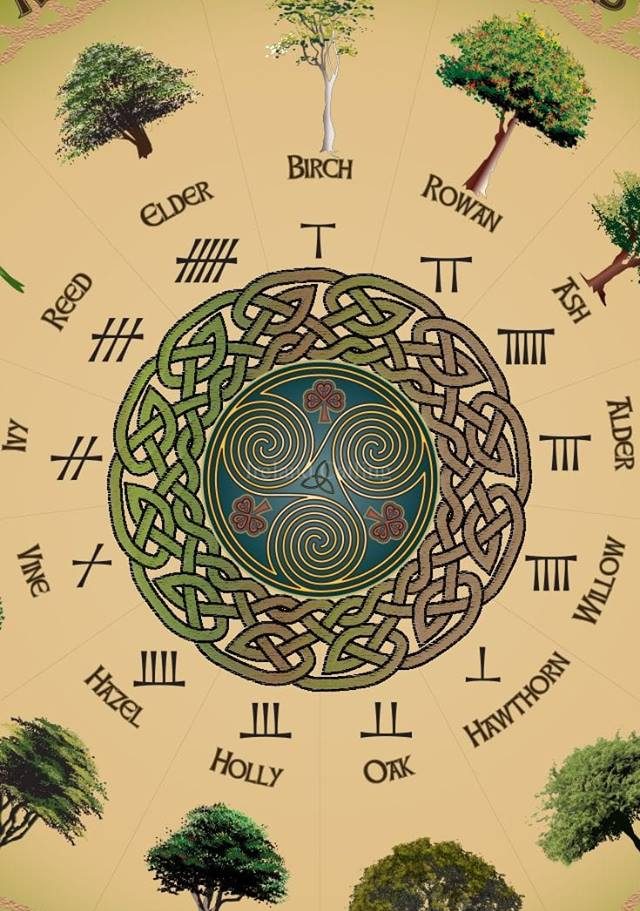
This is the wheel I follow and write about in my own practice:

Holly — Devotion & Protection

Holly is the Sacred Defender, teaching us to recognize what’s sacred enough to deserve our devotion and then protect it, not out of duty or obligation, but out of sovereignty.

Hazel — Wisdom & Intuition

Hazel invites us into a deeper relationship with wisdom, inspiration, intuition, and the kind of knowing that can’t always be explained logically.

Vine — Discernment

Vine asks us to notice what we’re consuming, attaching ourselves to, and allowing to influence us, helping us discern what truly nourishes us.

Ivy — Resilience

Ivy teaches us about persistence, adaptation, interdependence, and the ways we continue growing even when the path isn’t straight.

Reed — Truth

Reed invites us to listen beneath noise and performance for what’s actually true, and to allow that truth to move through our voices and our lives.

Elder — Release & Completion

Elder teaches us about endings, death, release, transformation, and the fertile emptiness that makes new beginnings possible.

Birch — Rebirth & Beginnings

Birch arrives with renewal, cleansing, possibility, and the courage to begin again.

Rowan — Protection & Vision

Rowan invites us to strengthen our relationship with intuition and spiritual protection while seeing beyond the immediately visible.

Ash — Relationship & Interconnection

Ash reminds us that nothing exists in isolation. Our bodies, relationships, communities, ancestors, ecosystems, and spiritual lives exist inside webs of relationship.

Alder — Aligned Movement

Alder asks us to move, but not simply for the sake of movement. What movement is actually aligned and Loving?

Willow — Emotional Wisdom & Flow

Willow teaches us that emotions aren’t interruptions to our path. They’re part of the path. She invites us to trust emotional movement, grief, intuition, receptivity, creativity, and the wisdom of Flow.

Hawthorn — Enchantment & Reverence

Hawthorn stands at the threshold between ordinary and extraordinary. She asks us to become available to enchantment, restore reverence, and remember that paying deeper attention doesn’t take us away from reality. It brings us more fully into it.

Oak — True Nature, Rootedness & Legacy

Oak asks: What are you becoming rooted in? For me, the answer became my own True Nature. Oak taught me to notice the acorn essence that has always been present, trust the timing of my own becoming, and think beyond immediate results toward impact, legacy, and the generations that come after me.

And then the wheel returns to where I started, or wherever you start.

Except we don’t return as the same people.

You don’t need to become a Celtic scholar to begin.

You don’t need an elaborate altar.

You don’t need to live beside an ancient forest.

And you definitely don’t need to do this perfectly.

The heart of the practice is relationship and attention.

At the beginning of each lunar cycle, I learn about the tree I’ll be walking with.

I might explore:

  • what the tree physically looks like and where it grows
  • what it’s doing during this particular Season
  • how it behaves within its ecosystem
  • Celtic mythology and folklore associated with it
  • its Ogham associations
  • traditional symbolism and folk practices
  • modern spiritual interpretations
  • what the tree might be reflecting about my own Life

Then I pay attention.

Maybe I encounter the tree unexpectedly.

Maybe a particular line in a book stays with me.

Maybe something happening in my Life suddenly mirrors the ecology of the tree.

Maybe I have a dream.

Maybe I notice an animal.

Maybe nothing dramatic happens at all, but spending a month with one question slowly changes the way I see something.

This year, I’m also weaving in some of what I’m learning through Ted Andrews’ Nature-Speak, which explores receiving intuitive messages through signs, omens, encounters, and patterns in Nature.

I’m becoming less interested in asking:

What does this tree mean?

And more interested in asking:

What is this relationship revealing?

That feels like a much more alive way to practice.

One of the most common ways people encounter the Celtic Tree Calendar online is through the idea of Celtic birth trees or Celtic tree astrology.

You can absolutely explore the tree associated with the lunar period around your birth.

In my own work, I call this your Birth Essence.

I think of it less like a personality test and more like another mirror.

What qualities of this tree feel familiar?

What gifts does it reflect?

What tensions?

What patterns have been present throughout your Life?

But I don’t think the point of the Celtic Tree Calendar is simply to discover “your tree” and stop there.

You aren’t only one tree.

The whole forest has something to teach you.

Walking the complete wheel lets us experience different relationships with strength, intuition, grief, protection, release, truth, enchantment, movement, belonging, and becoming.

Sometimes the tree that challenges us most becomes a more important teacher than the tree associated with our birth.

When I wrote about Holly for the first time, I told everyone very openly:

I’m learning this too.

I wasn’t presenting myself as an expert in some ancient system I’d studied for twenty years.

I was inviting people to walk beside me while I explored something that felt alive.

I kept going.

Holly became Hazel.

Hazel became Vine.

The Seasons changed.

The trees changed.

I changed.

Eventually, I arrived at Oak and realized I’d walked all thirteen trees.

And Oak gave me the language for something I think had been emerging underneath the entire year.

I became fascinated by the acorn.

Everything a magnificent Oak will ever become is somehow already held inside something small enough to fit in the palm of your hand.

The acorn doesn’t compare itself to the pine beside it.

It doesn’t wonder whether it’s behind.

It doesn’t question whether it should become a maple instead.

It simply responds to the Season it’s in, knowing and trusting that everything it needs has already been placed within it.

And I started thinking about the through-lines in our own lives.

The expressions change.

The essence stays the same.

The child becomes the teenager.

The teenager becomes the adult.

Our relationships change.

Our work changes.

Our beliefs change.

Our bodies change.

Our roles change.

And yet, when we look carefully, we can often recognize something that has been there all along.

Our acorn essence.

Our True Nature.

Maybe healing isn’t primarily about fixing ourselves.

Maybe it’s about removing everything that’s gotten in the way of our own Nature.

Maybe our work isn’t to become someone new.

Maybe it’s to become more fully who we’ve been all along.

That’s the theology of becoming that emerged for me after one year around the wheel.

And now I’m back at Holly.

That’s strange and beautiful to write.

Last year, Holly was new to me.

This year, she’s familiar.

But I’m different.

And I think that’s where the real practice begins.

The first time around the wheel, I was often asking:

What does this tree mean?

This time, I’m asking:

What does this tree reveal now that I’ve changed?

I’m also going deeper.

I want to learn more of the historically grounded Celtic folklore surrounding each tree.

I want to understand more of its actual ecology.

I want to notice what the physical tree itself can teach us rather than treating Nature only as metaphor.

And I want to deepen my practice of listening for the signs, synchronicities, encounters, and intuitive messages that arise when we become available to a more enchanted relationship with the living world.

I’m still learning.

I hope I always will be.

Because perhaps that’s another thing the trees have been teaching me.

A relationship with Nature isn’t something we master.

It’s something we keep showing up for.

The Moon circles again.

The Season returns.

And we meet each other differently.

What is the Celtic Tree Calendar?

The Celtic Tree Calendar is a modern spiritual framework that associates thirteen trees with thirteen lunar periods throughout the year. It’s inspired by Celtic tree lore, Ogham traditions, folklore, seasonal observation, and later spiritual interpretations.

Is the Celtic Tree Calendar historically accurate?

The specific thirteen-tree lunar calendar commonly used today isn’t an attested ancient Druidic calendar. It’s a modern synthesis inspired by older Celtic traditions, Ogham, folklore, and tree symbolism. I believe we can honor the traditions that inspire the practice while also being honest about its modern development.

What are the 13 trees of the Celtic Tree Calendar?

The thirteen trees in the version I follow are Holly, Hazel, Vine, Ivy, Reed, Elder, Birch, Rowan, Ash, Alder, Willow, Hawthorn, and Oak.

Different versions of the modern Tree Calendar may use different sequences, dates, or plants.

Is the Celtic Tree Calendar the same thing as Ogham?

No. Ogham is an early Irish writing system. Although trees and plants became associated with Ogham letters through medieval and later traditions, the modern thirteen-tree lunar calendar isn’t synonymous with the historical Ogham alphabet.

How do I find my Celtic birth tree?

Your Celtic birth tree is generally identified by finding which tree period includes your birth date within the particular Tree Calendar you’re following. Because modern versions use different dates and sequences, it’s important to know which version you’re using.

I call the tree associated with your birth your Birth Essence, but I encourage people to explore all thirteen trees rather than treating the calendar only as another zodiac system.

I’m now beginning my second full journey around the Celtic Lunar Tree Calendar.

Each New Moon, I’ll publish one in-depth guide exploring the tree we’re entering through its ecology, Celtic folklore and symbolism, intuitive teachings, seasonal wisdom, and reflection questions you can actually bring into your Life.

Then we’ll live with that tree together for the entire lunar cycle.

You don’t need to know anything about Celtic spirituality.

You don’t need Celtic ancestry.

You don’t need to believe Nature is sending you messages.

You only need to be willing to pay attention.

Because perhaps the question isn’t whether Nature is speaking.

Perhaps the question is whether we’ve become quiet enough to hear her.

Welcome to the wheel.

follow along with me

If you’d like to keep walking the Celtic Lunar Tree Calendar with me, I’d love to have you.

Each New Moon, I’ll share the next tree guide, exploring its ecology, Celtic folklore and symbolism, intuitive teachings, seasonal wisdom, and reflection questions to carry with you through the lunar cycle.

Get the next Celtic Lunar Tree Guide in your inbox as we move through all 13 trees together.

← Back

Thank you for your response. ✨